

Last updated: May 2026
One of the biggest differences between a rushed, unrealistic flight and a smooth, professional one comes down to a single skill: descent planning.
If you’ve ever found yourself too high on approach, diving toward the runway, or wondering why VNAV isn’t behaving properly, you’re not alone. This is one of the most common challenges in flight simulation, from beginners right through to experienced sim pilots.
In this guide, we’ll walk through why descent planning matters, and more importantly, how to do it properly using simple, reliable techniques.
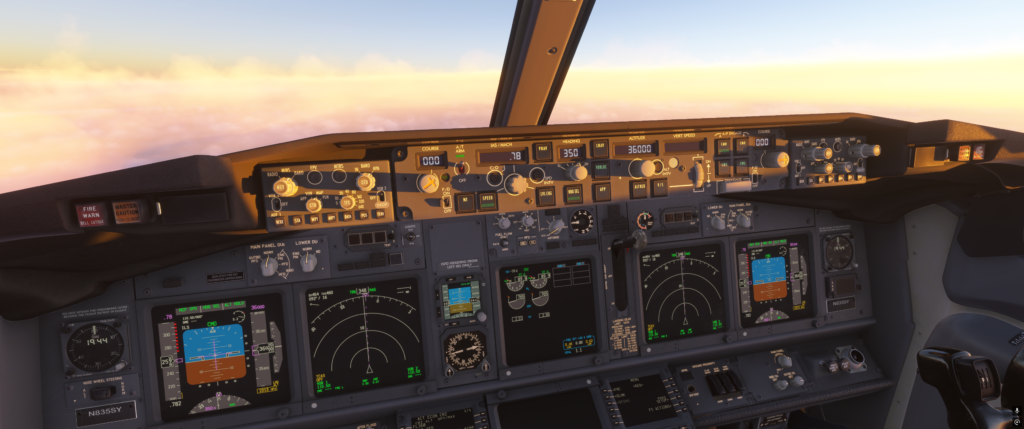
Why Descent Planning Matters
In real aviation, the descent phase is planned well in advance — often over 100 nautical miles before reaching the airport. The goal is simple: arrive at the correct altitude, at the correct speed, fully configured for a stable approach.
What Good Descent Planning Gives You
- Stable approaches — no last-minute corrections
- Realism — matching real-world airline procedures
- Smooth automation — VNAV works as intended
- Reduced workload — everything feels calm and controlled
What Happens Without It
- You end up too high near the airport
- You need to dive aggressively
- You miss the glide slope capture
- The entire approach becomes unstable
This is exactly what most sim pilots experience at some point — and it’s completely fixable.
The Foundation: The 3:1 Rule
This is the most important concept in descent planning, and once you understand it, everything starts to click.
The Rule
For every 1,000 feet you need to lose, allow 3 nautical miles.
Example
- Cruising at 30,000 ft
- Target altitude: sea level
- Altitude to lose: 30,000 ft
- 30 × 3 = 90 nautical miles
Result: Start your descent around 90 NM from the airport.
What a Proper Descent Profile Looks Like
A correct descent is not steep or rushed. It’s a long, shallow, controlled path that gradually brings the aircraft down to the approach phase.
The Key Phases
- Cruise: Level flight at altitude
- Top of Descent (TOD): Where descent begins
- Managed descent: Smooth, continuous descent
- Approach setup: Slowing down and configuring the aircraft
- Glide slope: Final descent to the runway
This is exactly what you should be aiming to replicate in your simulator.
Step-by-Step: How to Plan Your Descent
Step 1 – Determine Your Target Altitude
This is typically:
- The initial approach altitude from charts, or
- Approximately 3,000 ft above airport elevation
Step 2 – Calculate Altitude to Lose
- Cruise altitude minus target altitude
Example:
- 35,000 ft → 3,000 ft = 32,000 ft to lose
Step 3 – Apply the 3:1 Rule
- 32 × 3 = 96 NM
This gives you your Top of Descent (TOD).
Step 4 – Set Your Descent Rate
A simple and very effective rule:
- Groundspeed × 5 = descent rate (ft/min)
Example:
- 400 knots → 400 × 5 = 2,000 ft/min
Step 5 – Monitor Your Path
- Stay slightly ahead of the aircraft
- Adjust early if needed — not late
- Avoid large corrections near the airport
Using VNAV (737 and Airliners)
Modern aircraft like the Boeing 737 can manage descent automatically using VNAV — but only if everything is set up correctly.
What VNAV Does
- Calculates the descent path
- Maintains an efficient vertical profile
- Follows altitude and speed constraints
Common Issues
- Incorrect FMC setup
- Missing altitude constraints
- Starting descent too late
- Over-reliance on automation
Even with VNAV, understanding descent planning is essential. It allows you to verify that the aircraft is doing the right thing.
General Aviation Descent (Cessna, etc.)
In smaller aircraft, descent is simpler but still requires planning.
- Typical descent rate: 500–800 ft/min
- Shorter descent distance
- More visual judgment
The same principles apply — just scaled down.
Advanced Tips for Better Descents
- Think ahead: Start planning 150–200 NM out
- Use STARs: Follow published altitude constraints
- Watch speed: Avoid overspeeding during descent
- Use speed brakes sparingly: They are not a primary solution
- Stay ahead of the aircraft: Anticipation is key
Summary
- The 3:1 rule is your foundation
- A proper descent is long, smooth, and controlled
- VNAV is helpful — but not a substitute for understanding
- Good planning results in stable, professional approaches
Once you master descent planning, your flights will feel completely different — smoother, more realistic, and far more enjoyable.

- You Know You’re a Flight Simmer When… - 12 August 2026
- Pete’s Ultimate MSFS 2024 Graphics Settings Guide - 1 August 2026
- How to Use GSX with the PMDG 737-800 in MSFS 2024. - 20 July 2026