
Why plane add-ons matter more than beginners expect
Our list of the Best MSFS 2024 Aircraft Addons. If you’ve just started flying in Microsoft Flight Simulator, the default planes probably feel impressive at first. They look good, they fly reasonably well, and they let you explore the world instantly. That’s intentional. Default airplanes are designed to work for everyone, from total beginners to casual fliers.
Plane add-ons are different. They are designed to work well for specific types of flying and specific kinds of simmers. This difference is where many beginners get stuck. You’ll see people online confidently declaring that a particular plane is “the best in the sim” or “essential”.
What they usually leave out is that it’s the best for their flying style, not necessarily yours. This article exists to help you avoid that trap. It aims to answer one very practical question. What plane should I fly next? This depends on how I want to use the simulator.
Aircraft, Airports, and Add-on Guides
These guides highlight the best aircraft, scenery, and airport enhancements available for Microsoft Flight Simulator 2024, helping you expand realism, variety, and immersion beyond the default simulator experience.
Microsoft “Handcrafted” Airports in MSFS 2024
Discover the premium handcrafted airport locations included with the simulator and what makes them visually special.
What an airplane addon actually is
A plane addon is a third-party airplane you buy separately and install into MSFS. These planes are built by specialist developers rather than Microsoft or Asobo.
Compared to default airplanes, addons usually offer more realistic flight behavior. They give deeper and more precise systems. Addons also deliver higher visual fidelity in the cockpit and exterior. Furthermore, they give a stronger sense of immersion and workload.
What they also demand is more from you as the pilot. More realism means more decisions, more procedures, and sometimes more frustration if you jump in too early.
Realism is not a reward by itself. It only becomes enjoyable when it matches your experience level and the flying you actually enjoy.
Why beginners often buy the wrong aircraft
Most beginners make aircraft decisions emotionally rather than practically. The Jets look exciting. Big airliners look serious. Study-level aircraft sound impressive.
The problem is that aircraft are tools, not trophies.
If the aircraft you choose doesn’t match your skills, it can start to feel like work. It may not align with your available time or your expectations. The simulator stops being fun. Many people quietly stop flying. They do not stop because MSFS is bad. Instead, they chose aircraft that were too complex too early.
The easiest way to avoid this is to think in terms of categories rather than individual aircraft.
The truth is that it can all be a little overwhelming at times. A lot of addons dont come cheap, so take your time. Take a look at our beginner tips for flight simulator before you buy.
The four plane categories every beginner should understand
Instead of asking “what’s the best plane?”, a better question is “what role do I want this aircraft to play?”
Almost every aircraft addon fits into one of the following four categories.
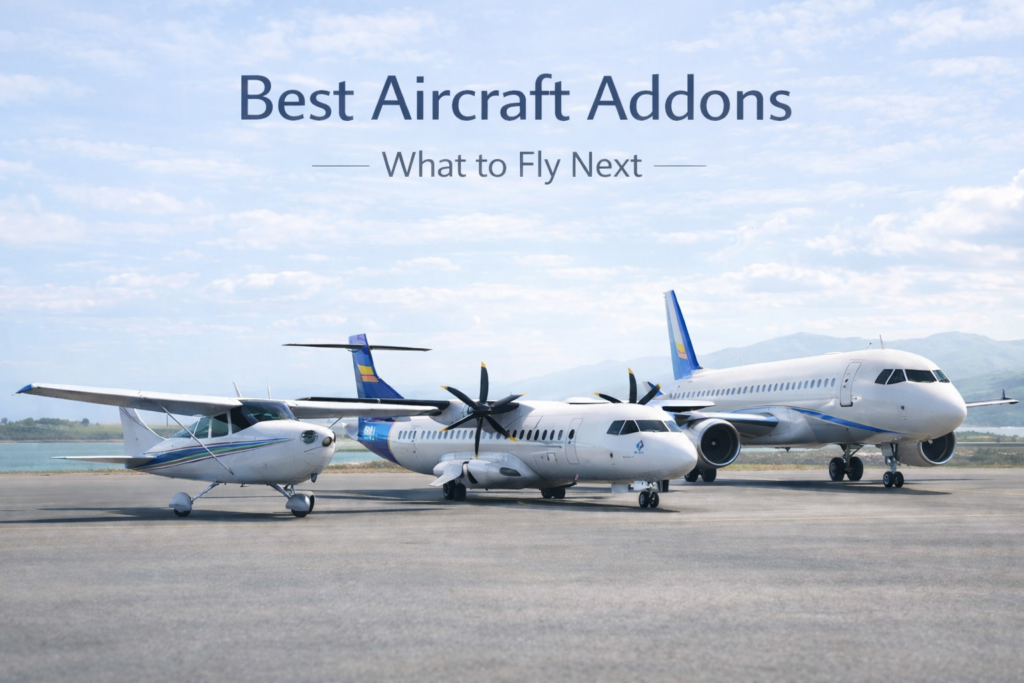
Small general aviation aircraft (learning to actually fly)
These aircraft are ideal for complete beginners and for anyone who wants to feel connected to the act of flying.
They are usually single-engine piston aircraft with modest speeds, simple systems, and forgiving handling. You hand-fly most of the time, navigate visually, and stay close to the ground.
This category is where you build real flying instincts. You learn how pitch, power, and trim interact. You learn how the weather affects a light aircraft. You learn how to land consistently rather than relying on automation.
These aircraft are perfect for short flights, sightseeing, bush flying, and relaxed exploration. Mistakes are survivable, and progress feels natural.
Even very experienced simmers return to this category regularly because it’s where flying feels most direct and enjoyable.
Turboprops (the perfect bridge between props and jets)
Turboprops are one of the most underappreciated categories for beginners.
They are faster and more capable than piston aircraft but far less overwhelming than jets. You’ll typically fly regional routes of 30 to 90 minutes, often between smaller airports with interesting approaches.
This is where flight planning starts to matter. You begin thinking about climb profiles, power management, and descent planning. You still hand-fly when you want to, but you also start using automation as a tool rather than a crutch.
Many simmers describe turboprops as the point where everything suddenly makes sense. You’re flying real routes, managing systems that matter, and still enjoying the scenery rather than rushing above it.
If you ever feel unsure about jumping into jets, turboprops are usually the smartest next step.
Regional and narrow-body jets (structured airline flying)
This category suits simmers who enjoy procedure, structure, and realism over pure stick-and-rudder flying.
Modern jets are not difficult to fly physically. They are difficult to understand conceptually. Most of your work happens before takeoff and during descent, not while cruising. Furthermore, while nice cloud formations can be mesmerizing, there isn’t much scenery to see, depending on the graphics settings for addon aircraft in your simulator.
You’ll interact with flight computers, autopilot modes, and standard operating procedures. Flights feel purposeful and repeatable. You start flying realistic airline routes between major airports, following real schedules and practices.
If you enjoy learning systems gradually and tracking checklists, this category becomes very rewarding. You will feel like you’re operating a machine rather than simply flying it.
The key is patience. Jets are best approached methodically, one system at a time.
Long-haul and study-level aircraft (save these for later)
Study-level airplane aims to replicate real-world operations in extreme detail. They simulate failures, edge cases, and airline workflows with very little hand-holding.
These aircraft assume you already understand navigation, automation logic, and airline procedures. They reward deep learning but punish rushing.
They are not bad choices. They are simply bad early choices.
Many beginners buy one of these aircraft too soon, feel overwhelmed, and lose confidence. There is no achievement unlocked for struggling unnecessarily. These aircraft are far more enjoyable when you grow into them naturally.
How to choose the right aircraft for you
Choosing well comes down to honesty rather than ambition.
Think about how long you want your flights to be. Short sessions suit general aviation. Medium sessions suit turboprops and regional jets. Long sessions suit jets.
Think about how hands-on you want to be. If you enjoy flying the aircraft yourself, general aviation and turboprops will feel better. If you enjoy managing systems and procedures, jets will appeal more.
Think about why you fly. If flying helps you relax, avoid jumping into complexity too quickly. If learning and challenge motivate you, structured aircraft will eventually feel satisfying.
There is no correct path. There is only the path that keeps you flying.
A very common beginner mistake
Buying too many aircraft too quickly.
This usually leads to shallow learning, constant switching, and a sense that nothing feels quite right. Depth beats variety, especially early on.
Choosing one aircraft and learning it properly creates far more satisfaction. Flying it often is more rewarding than owning a hangar full of barely understood planes.
Now that you understand the basics, the most important improvement you can make is to correctly set the performance settings for smooth flying.
Read the Performance & Settings Guide to reduce stutters, improve FPS, and make the simulator feel truly enjoyable.
Next article: Best Realistic Settings