
The History of Microsoft Flight Simulator began between 1977 and 1983, when primitive graphics and pioneering ideas proved that real flight could exist on a personal computer. Explore the earliest days of Microsoft Flight Simulator from 1977 to 1983, when primitive graphics, bold innovation, and personal computers launched a simulation legend.
If you want to understand why Microsoft Flight Simulator still matters today, you really do have to go back to the very beginning. Not to powerful PCs, detailed scenery, or complex aircraft systems — but to a time when simply seeing a horizon move on a screen felt like magic.
The late 1970s and early 1980s were a very different world for computing. Machines were slow, memory was measured in kilobytes, storage came on floppy disks, and colour displays were a luxury rather than the norm. And yet, somehow, this was where flight simulation took its first real steps.
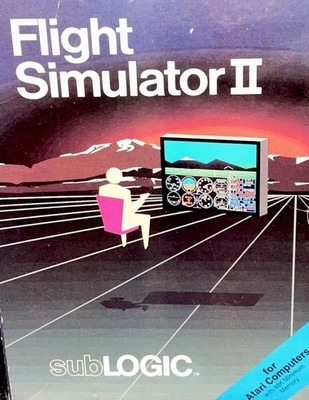
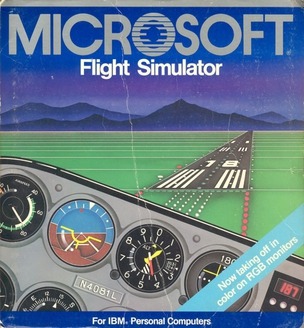
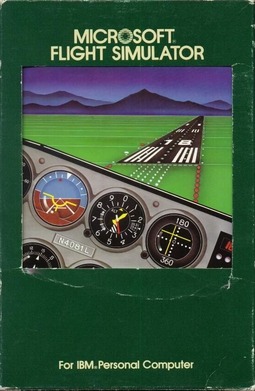
Computers of the time
Early personal computers weren’t built for entertainment, let alone simulation. They were noisy, slow, and often temperamental. Booting a machine could take time, and loading software from a floppy disk required patience — lots of it.
Most systems had:
- extremely limited memory
- very basic graphics
- simple keyboards (no mice yet)
- monochrome or low-resolution colour monitors
There were no GPUs, no multi-core processors, and no expectation of smooth performance. If something moved convincingly on screen, it was impressive.
The first simulators
The earliest versions of Flight Simulator were astonishingly simple by modern standards — but revolutionary for their time. The world was sparse, the aircraft basic, and the instruments minimal. There were no satellite images, no real-world weather, and certainly no detailed airports.
And yet, for the first time, you could:
- Control an aircraft
- Watch the horizon tilt as you banked
- climb, descend, and turn, and feel a sense of being somewhere else
It wasn’t about realism as we define it today. It was about imagination filling in the gaps.
What it felt like to fly
This is hard to explain unless you were there.
Flying in these early simulators required patience and curiosity. Frame rates were low. Controls felt crude. Sometimes the simulator struggled just to keep up. But when everything lined up — when the screen responded, and the aircraft behaved as expected — it felt deeply rewarding.
You weren’t chasing perfection. You were discovering a possibility.
Many users weren’t pilots. Some had never even been in a small aircraft. But for the first time, aviation felt accessible — something you could explore from your desk at home.
- Limitations? Plenty. Magic? Absolutely.
- By modern standards, Era 1 simulators were full of limitations:
- Simple wireframe or blocky graphics
- Very basic flight models
- Little sense of scale or geography
But those limitations didn’t matter as much as you might think. In fact, they encouraged imagination. The simulator gave you just enough information to believe, and your mind did the rest.
That sense of “what if?” — what if this could be better, smoother, more detailed — was already there.
A foundation quietly laid
Looking back now, it’s remarkable how much was achieved with so little. Era 1 didn’t try to be everything. It didn’t promise realism or accuracy in the modern sense. What it did do was prove that flight simulation belonged on personal computers — and that people wanted it.
Everything that came later was built on this foundation.
The computers would get faster. The graphics would improve. The worlds would grow larger and more detailed. But the core idea — sitting down and flying, simply for the joy of it — was already firmly in place.
And with that foundation laid, flight simulation was ready to move into its next phase.