
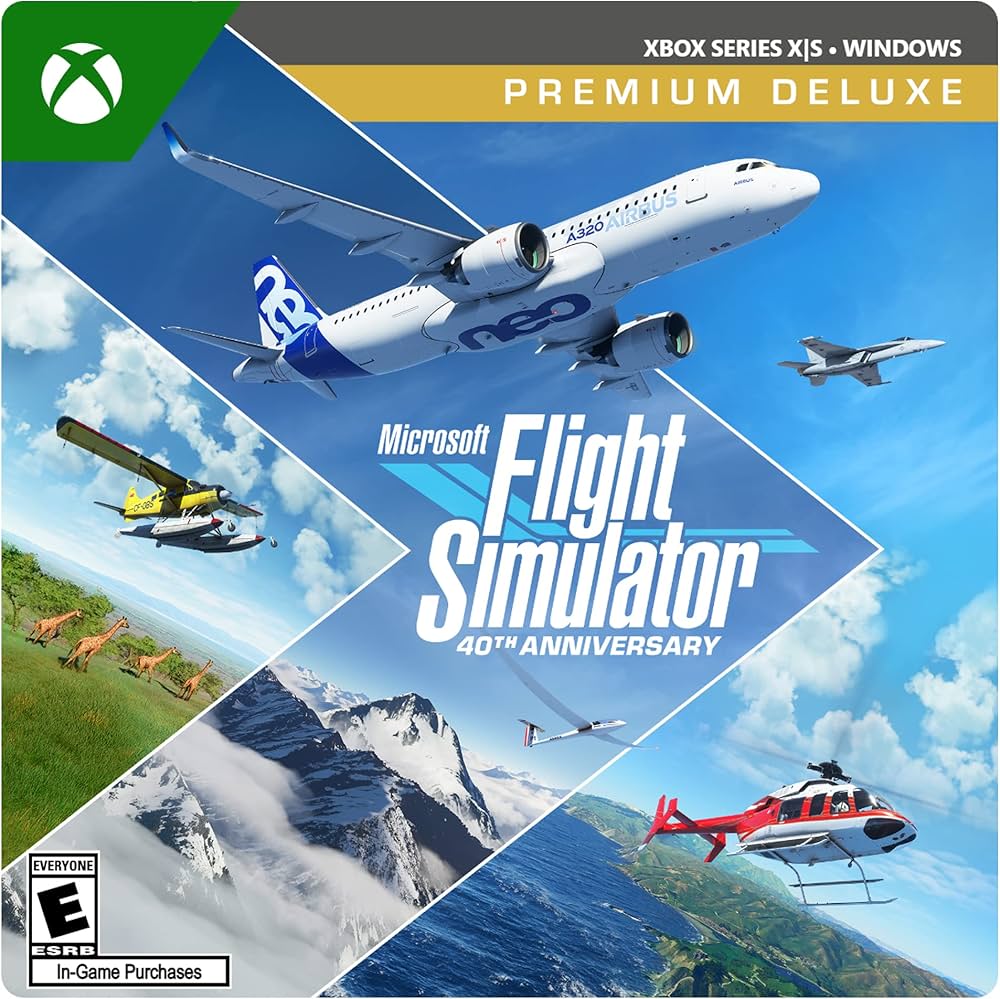
The History of Microsoft Flight Simulator Era 6 — A New Beginning (2020–Present). Beginning in 2020, Microsoft Flight Simulator returned with breathtaking global scenery, live weather, and technology that redefined what home flight simulation could become. After years of uncertainty, flight simulation didn’t just return — it re-entered the spotlight in a way few could have imagined.
Era 6 represents more than a technical upgrade. It marks a reset — a moment where flight simulation stepped out of its niche and reintroduced itself to a much wider audience.
A fresh start
When the modern era of flight simulation arrived, it was immediately clear that something fundamental had changed.
This wasn’t just an update built on old foundations. It was a rethinking of what a flight simulator could be — visually, technically, and culturally.
For the first time:
- The entire world was available
- Scenery felt alive and recognisable
- Flying anywhere felt meaningful
You no longer had to imagine the landscape — you could see it.
Technology finally aligned
What made Era 6 possible wasn’t just ambition — it was timing.
By this point:
- Modern CPUs and GPUs were powerful enough
- Internet connectivity was fast and widespread
- Cloud technology could be leveraged
- Storage and memory were no longer major constraints
Flight simulation could finally take advantage of modern computing rather than fighting against it.
The result was an experience that felt expansive, fluid, and alive.
A broader audience returns
Perhaps the most striking change in Era 6 was who came back — and who arrived for the first time.
Long-time simmers returned, curious to see what had changed. New users discovered flight simulation through visuals alone, often without any prior aviation background.
For some, it became:
- A learning tool
- A creative outlet
- A way to relax
- A way to explore the world
Flight simulation once again felt accessible, without losing its depth.
Depth still matters
Despite the visual leap, Era 6 didn’t abandon realism.
Serious simulation:
- Procedures
- Navigation
- Aircraft systems
remained central for those who wanted it. Third-party developers once again played a vital role, expanding the simulator in directions that catered to both casual flyers and dedicated enthusiasts.
The difference this time was choice.
You could fly casually — or deeply.
You could explore — or train.
Keep it simple — or go all in.
A living platform
Unlike previous eras, Era 6 doesn’t feel finished.
The simulator continues to evolve:
- Updates arrive regularly
- New aircraft and systems appear
- The community actively shapes its direction
Flight simulation is no longer something you install and leave unchanged for years. It’s a living platform — growing, adapting, and improving over time.
Looking back, looking forward
Seen as a whole, the six eras tell a remarkable story.
From wireframe horizons and floppy disks, through golden years and uncertain transitions, to a modern, connected world — flight simulation has quietly reflected the evolution of personal computing itself.
What’s remained constant is the appeal:
- The freedom of flight
- The satisfaction of learning
- The joy of exploration
Era 6 doesn’t replace what came before — it builds on it.
And just like those early simulators, it leaves one question hanging in the air:
Where do we go next?
Final thoughts
Flight simulation has never been just about technology. It’s about curiosity, patience, imagination, and the simple pleasure of flying — wherever and however you choose to do it.
That spirit has survived every era.
And it’s very much alive today.