
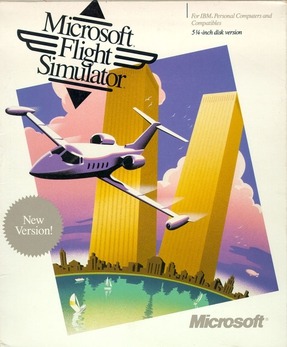
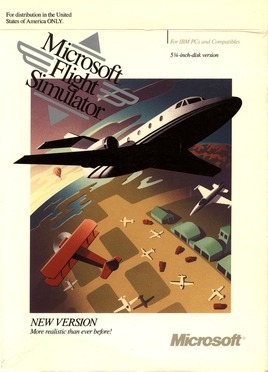
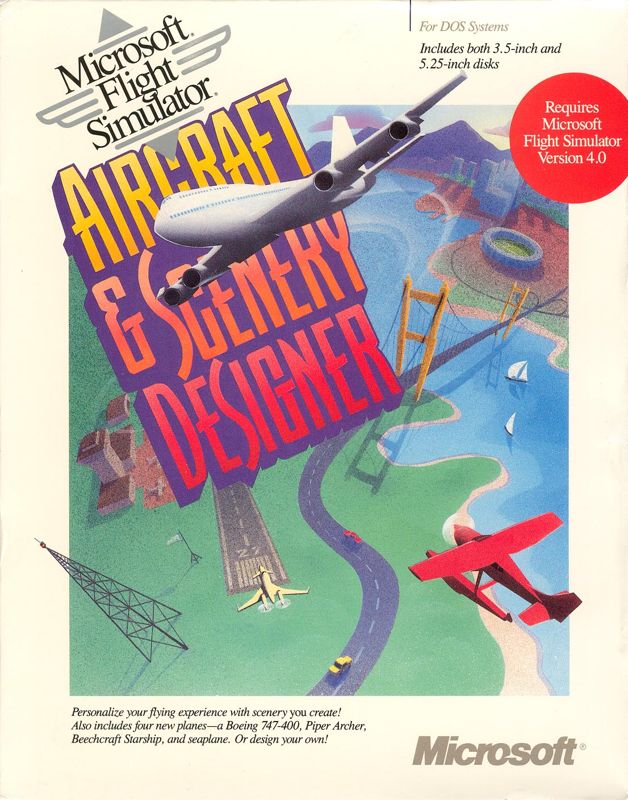
The History of Microsoft Flight Simulator. Between 1984 and 1988, Microsoft Flight Simulator evolved rapidly, improving realism, expanding features, and reaching a growing generation of home PC pilots. By the mid-1980s, something important had changed. Personal computers were still slow by today’s standards, but they were becoming more capable — and people were starting to expect more from them.
Flight simulation was no longer just a clever technical demonstration. It was beginning to feel like a proper hobby.
Computers were getting better… slowly
This era didn’t arrive with a sudden leap in technology. Instead, improvements came gradually — but noticeably.
Computers now had:
- a little more memory
- better colour graphics
- improved sound (sometimes)
- faster processors, though still painfully slow
Hard drives were starting to appear, but floppy disks were still very much part of daily life. Loading times were long, and crashes weren’t uncommon. The dreaded blue screen was never far away.
But when things worked, you could feel that progress was happening.
The simulator starts to take shape
During Era 2, flight simulation began to look and feel more intentional. The basic flying experience was still simple, but there was more structure now — more thought given to how the simulator behaved and what it tried to represent.
You could see:
- clearer instruments
- improved horizon and terrain rendering
- a growing sense of space
It still wasn’t realistic in the modern sense, but it was becoming more believable. The simulator wasn’t just showing movement anymore — it was starting to suggest a world.
A growing audience
Something else changed during this time: who was using flight simulators.
More people were discovering them — not just programmers or tech enthusiasts, but everyday computer owners. Some were drawn in by aviation, others by curiosity, and some simply by the idea that their computer could do something so unusual.
For many users, this was their first taste of “serious” simulation. It wasn’t a game you could master in five minutes. It demanded patience, experimentation, and a willingness to learn.
And that was part of the appeal.
Still limited — but confidence was growing
Let’s be clear: Era 2 simulators were still full of limitations.
- Frame rates could be painfully low
- Controls felt stiff
- Visual detail was minimal
- Navigation was basic at best
But compared to Era 1, there was a growing confidence. The simulator felt less like an experiment and more like a platform that could be built upon.
You could sense that this wasn’t the end of the road — it was the beginning of something bigger.
The imagination gap narrows
One of the most interesting shifts in Era 2 was how much less imagination you needed to “fill in the gaps”.
The simulator still relied on the user’s imagination, but it was starting to do more of the work itself. The illusion of flight held together for longer. You could settle into a session and forget, just briefly, about the limitations of the hardware.
That feeling — when the technology fades into the background — is something flight simulation has always chased. And in Era 2, it was becoming achievable for moments at a time.
Setting the stage for what came next
By the end of the 1980s, flight simulation had found its footing. It had survived its experimental phase and proven there was a genuine audience willing to invest time and effort into the experience.
The groundwork was laid:
- Better computers were on the way
- Expectations were rising, and the idea of realism was beginning to take hold
The next era would take full advantage of this momentum, as personal computers became more powerful and flight simulation began to resemble something much closer to what we recognise today.