
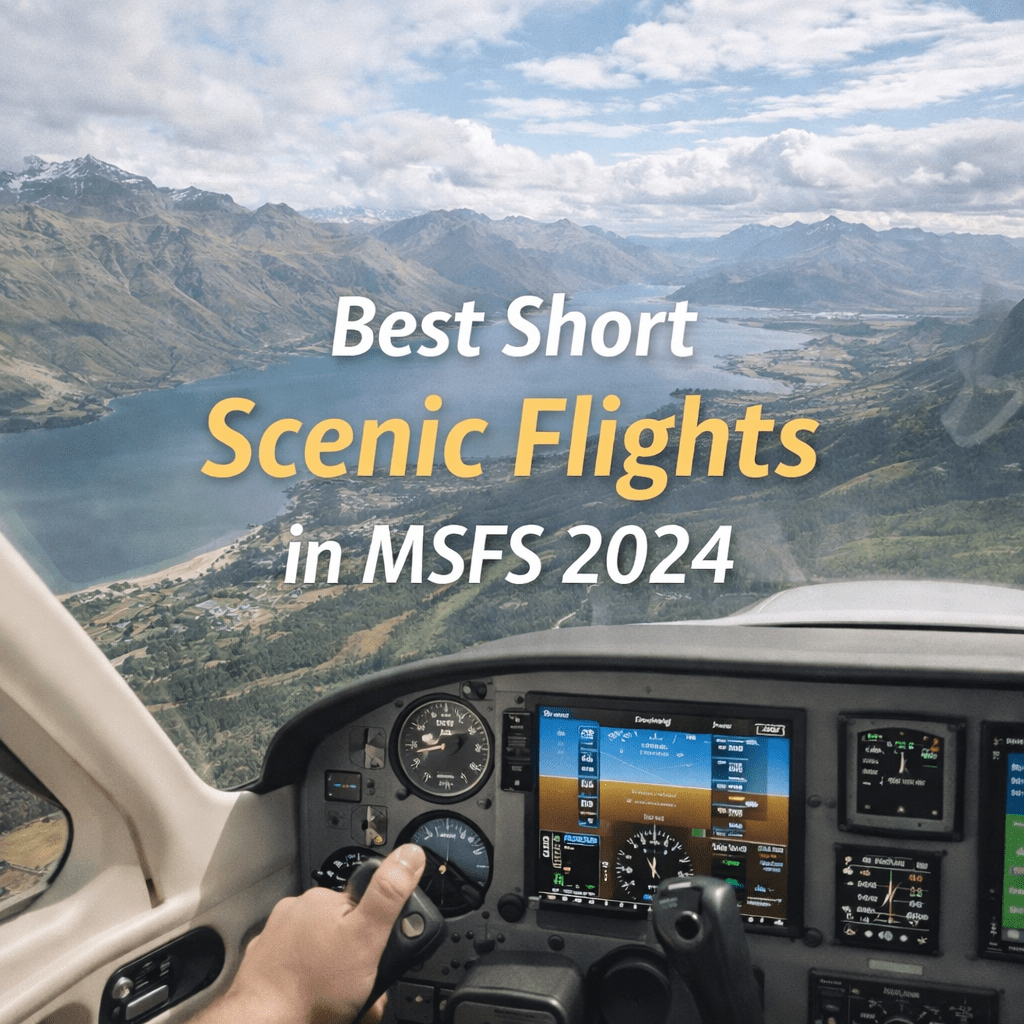
(Beautiful Routes You Can Fly in Under 90 Minutes)
If you’re looking for enjoyable routes while learning the simulator, our Microsoft Flight Simulator 2024 Beginner Guide explains the essential setup, controls, and flight basics that make the journeys in this Best Short Scenic Flights in MSFS 2024 guide easier to follow.
Why are Short Scenic Flights in MSFS 2024 often the most enjoyable?
Discovering the best short scenic flights in MSFS 2024 is one of the most enjoyable ways to explore the simulator’s detailed world without committing to long flight times.
If you’re still learning the fundamentals of navigation, aircraft control, and basic procedures, our Microsoft Flight Simulator beginner’s guide provides a clear starting point that makes scenic flying more relaxed and rewarding from the very first take-off.
Long airline sectors can feel realistic, but they also include:
- Extended cruise time
- Autopilot monitoring
- Long stretches with little visual change
Short scenic flights are different. They deliver:
- Continuous visual interest
- Hands-on flying from start to finish
- Memorable departures and landings
- A complete experience in a limited time
For many simmers, short scenic routes become the most frequently flown and most enjoyable part of Microsoft Flight Simulator.
What makes a scenic flight truly memorable
Not every short flight feels special.
The most memorable routes usually include at least one of the following:
- Dramatic mountains or valleys
- Coastlines, islands, or water crossings
- Famous cities or landmarks
- Challenging terrain approaches
- Changing weather or lighting conditions
When scenery changes throughout the flight, even 30 minutes in the air can feel rich and meaningful.
The ideal length for short MSFS flights
A practical sweet spot for scenic flying is:
- 20–40 minutes for relaxed VFR exploration
- 40–70 minutes for turboprop regional hops
- 60–90 minutes for short jet sectors
These lengths provide:
- Full departure and arrival experience
- Minimal cruise boredom
- Easy completion in a single session
Short flights fit naturally into real daily life, which is why they remain so popular.
Best aircraft types for scenic flying
Different aircraft create very different scenic experiences.
Light aircraft
Perfect for:
- Low-altitude sightseeing
- Following rivers, coastlines, and roads
- Slow, immersive exploration
Turboprops
Ideal balance of:
- Speed and visibility
- Regional realism
- Hands-on flying
Small jets
Best for:
- Short real-world airline routes
- Structured departures and arrivals
- Fast but complete flights
Choosing the right aircraft often matters more than the route itself.
Five beautiful, short scenic flights to try
1. Queenstown to Milford Sound, New Zealand
Flight time: ~25 minutes
Aircraft: Light aircraft or turboprop
This is one of the most famous scenic flights in the simulator.
You’ll fly through:
- Steep alpine valleys
- Snow-covered peaks
- Dramatic fjord landscapes
The arrival in Milford Sound feels cinematic even in clear weather.
2. Innsbruck to Salzburg, Austria
Flight time: ~40 minutes
Aircraft: Turboprop or regional jet
This route offers:
- Dense Alpine terrain
- Beautiful European valleys
- A satisfying city arrival
It combines mountain flying with real-world regional realism.
3. Naples to Palermo, Italy
Flight time: ~55 minutes
Aircraft: Turboprop or short-haul jet
Highlights include:
- Mediterranean coastline
- Mount Vesuvius departure views
- Island arrival over deep blue water
Perfect for golden-hour lighting and relaxed realism.
4. Vancouver to Victoria, Canada
Flight time: ~25 minutes
Aircraft: Turboprop or seaplane
A calm coastal hop featuring:
- Forested islands
- Ocean crossings
- Gentle regional atmosphere
Short, peaceful, and visually rich from start to finish.
5. Las Vegas to Grand Canyon, USA
Flight time: ~45 minutes
Aircraft: Light aircraft or turboprop
This flight delivers:
- Desert landscapes
- Hoover Dam flyover
- One of the world’s most dramatic natural wonders
Ideal for sunrise or sunset lighting.
How lighting transforms scenic routes
The same route can feel completely different depending on the time of day.
For the most photorealistic experience:
- Fly early morning for soft haze and calm colour
- Choose late afternoon for long shadows and depth
- Use golden hour for cinematic warmth
Lighting often matters more than graphics settings when creating beauty.
Adding weather for atmosphere, not difficulty
Scenic flying does not require storms or extreme conditions.
In fact, the most realistic atmosphere usually includes:
- Light haze
- Broken cloud layers
- Gentle wind
- Soft overcast light
These conditions enhance:
- Depth perception
- Colour realism
- Sense of scale
Subtle weather almost always looks more real than dramatic weather.
Turning short flights into meaningful experiences
A short flight becomes memorable when you:
- Choose a beautiful route intentionally
- Match aircraft to scenery
- Fly during realistic lighting
- Focus on a smooth landing
- Take a moment to enjoy the arrival
These simple habits transform MSFS from time-passing into true experience.
Why short scenic flying never gets old
Unlike long procedural flights, scenic routes offer:
- Endless global variety
- Quick satisfaction
- Continuous discovery
- Easy repetition with new lighting or weather
Because of this, short scenic flying often becomes the most enduring joy in the simulator.
Final thought
Microsoft Flight Simulator gives you the entire world,
but short scenic flights let you truly experience it.
You don’t need hours in the air to feel immersed.
Sometimes, the most memorable journeys last less than one hour—
Yet stay with you far longer.
Planning short scenic routes becomes even more immersive when real-world routing and fuel calculations are used. Many flight simulation pilots rely on professional planning tools such as SimBrief to create realistic routes that integrate smoothly with Microsoft Flight Simulator, helping transform a simple scenic hop into a believable aviation experience.